

Short answer: Health is big business: people spent 6.8 trillion dollars on wellness in 2024. That is not good news. It grows because we move less. Low fitness carried 5 times the risk of death in one large study. The answer is cheap: build endurance, and keep it.
In this article
- Wellness spending reached 6.8 trillion US dollars in 2024, up 7.9% in a year.
- Adults who do not move enough rose from 23.4% in 2000 to 31.3% in 2022.
- The lowest fitness carried about 5 times the risk of death of the fittest.
- Aim for about 150 minutes a week of moderate activity.
- Fitness fell 7% in 3 weeks off, but trained people stayed fitter than the untrained.
Health is now a very big business
People spent 6.8 trillion US dollars on wellness in 2024, by the count of the Global Wellness Institute. That was 7.9% more than the year before. Gyms, supplements, wellness apps, diet plans and fitness gadgets all sit inside that number.
Everyone calls this a boom. For a doctor, it is not good news. A market grows when there is a need, and here the need is that our bodies are moving less and getting weaker.
It grows because we move less
Machines and AI do more of our work, and more of it is done sitting down. A count from 507 surveys in 163 countries found that 23.4% of adults did not move enough in 2000. By 2022 it was 31.3%. That is 1 in 3 adults.
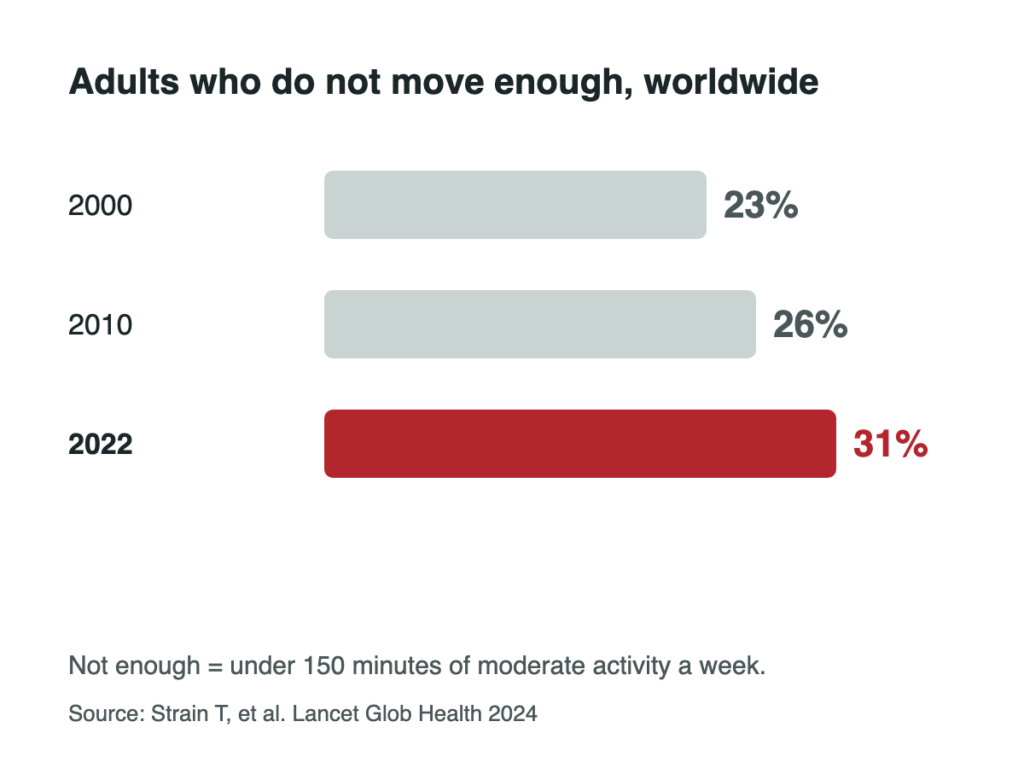
Not enough means under 150 minutes of moderate activity a week, or 75 minutes of hard activity. Brisk walking counts as moderate. So health is big business because so many of us fall short of a simple weekly target.
Low fitness costs more than you think
In a study of 122,007 people who did a treadmill test and were followed for about 8 years, those with the lowest fitness had about 5 times the risk of death of the fittest group. In the same study, that was a bigger jump in risk than smoking (1.4 times) or diabetes (1.4 times). This shows a link, not proof that low fitness alone caused the deaths.
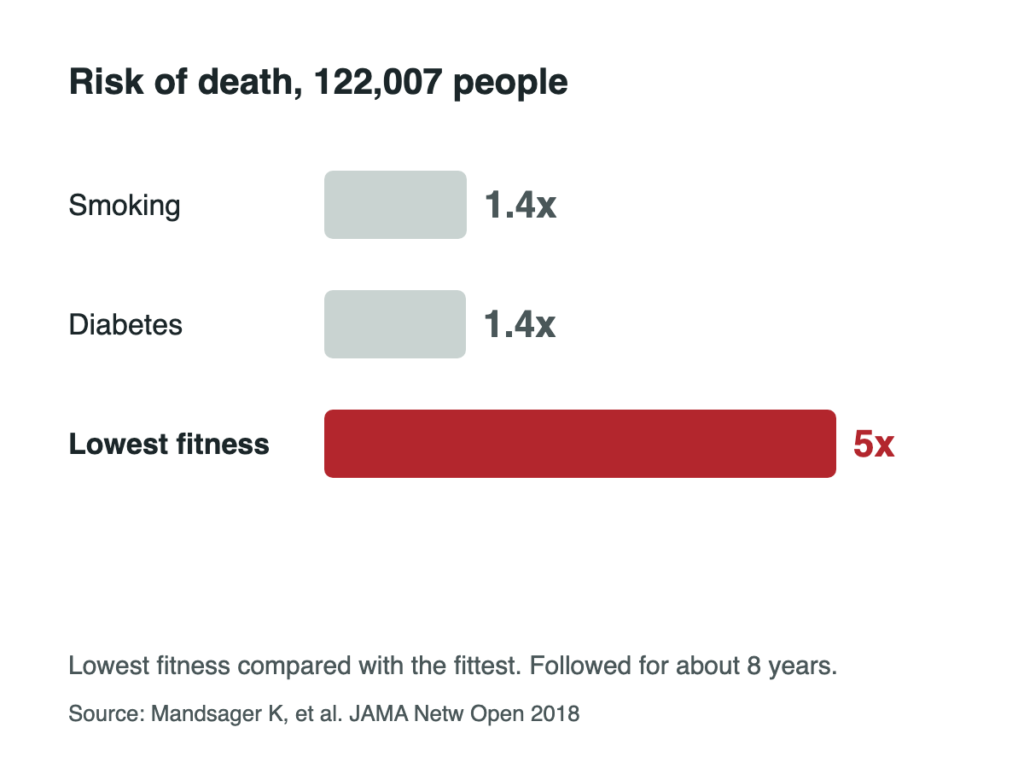
The hopeful part: fitness is something you can change. The same study found no top limit. More fitness was better, all the way up.
Start building endurance
Walk, cycle or run at a pace where you can talk but not sing. Aim for about 150 minutes a week, the line used in the world count. Spread it over most days. Start where you are and add a little each week.
If you have heart disease, diabetes or high blood pressure, start with your doctor. A physician supervised exercise intervention sets the safe start and adds load step by step. Physician supervised, exercise based cardiac rehab is built on exactly this kind of steady, regular session.
If you have it, keep it
Fitness fades when you stop. In a small study of 7 trained athletes who stopped training, fitness fell 7% in the first 3 weeks. By 8 weeks it was 16% lower and then held there. The first drop came because the heart pumped less blood with each beat.
Not all was lost. After 12 weeks off, they were still fitter than people who had never trained. So a break is not the end. Lace up and start again, a little at a time.
Your questions, answered
Why is health such a big business now?
Because more people need help with their health. Wellness spending reached 6.8 trillion dollars in 2024 (Global Wellness Institute), while the share of adults who do not move enough rose to 31.3% in 2022 (Strain 2024).
How much exercise do adults need?
At least 150 minutes of moderate activity a week, or 75 minutes of hard activity. That is the line used to count who moves enough (Strain 2024). Brisk walking counts. Spread it over most days of the week.
Is low fitness really as bad as smoking?
In one study of 122,007 people, the lowest fitness carried about 5 times the risk of death of the fittest, a bigger jump than smoking or diabetes in the same study (Mandsager 2018). This shows a link, not proof of cause.
What happens to fitness if I stop exercising?
It falls. In 7 trained athletes, fitness dropped 7% in 3 weeks and 16% by 8 weeks. After 12 weeks off they were still fitter than people who never trained (Coyle 1984). So start again; not all is lost.
Start safely, with your doctor
A physician supervised exercise intervention, 3 days a week, builds endurance step by step. The runner’s side is on Telangana Runners: build endurance and keep it. General advice: your own doctor knows your health.
info@cardiacrehab.com · www.CardiacRehab.com
Cardiac Rehab, 7B Journalist Colony, Film Nagar, Jubilee Hills, Hyderabad, Telangana 500096
References
- Global Wellness Institute. Wellness Economy Statistics & Facts (Global Wellness Economy Monitor 2025). globalwellnessinstitute.org/press-room/statistics-and-facts
- Strain T, Flaxman S, Guthold R, et al. National, regional, and global trends in insufficient physical activity among adults from 2000 to 2022: a pooled analysis of 507 population-based surveys with 5.7 million participants. Lancet Glob Health. 2024. pubmed.ncbi.nlm.nih.gov/38942042
- Mandsager K, Harb S, Cremer P, et al. Association of cardiorespiratory fitness with long-term mortality among adults undergoing exercise treadmill testing. JAMA Netw Open. 2018. pubmed.ncbi.nlm.nih.gov/30646252
- Coyle EF, Martin WH, Sinacore DR, et al. Time course of loss of adaptations after stopping prolonged intense endurance training. J Appl Physiol. 1984. pubmed.ncbi.nlm.nih.gov/6511559