
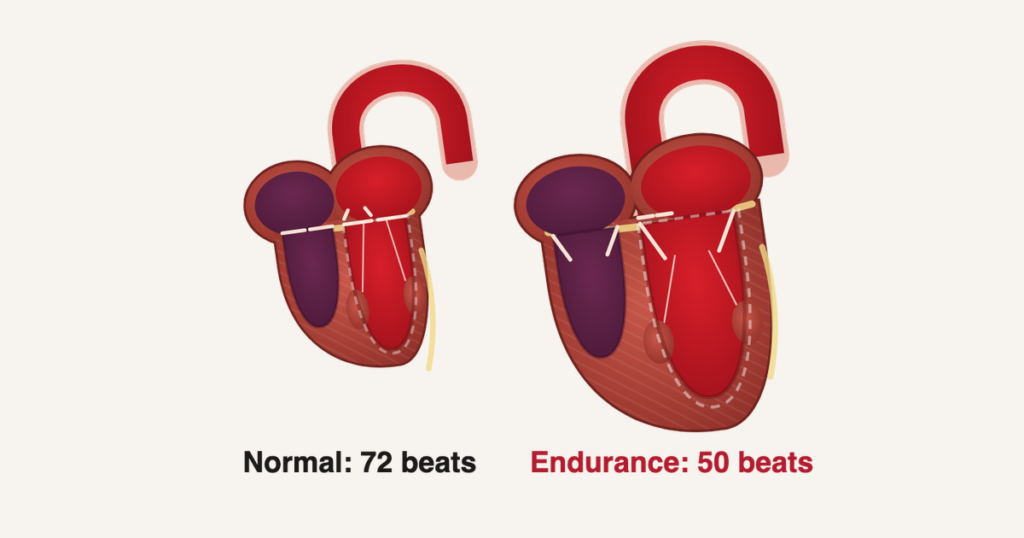
Short answer: A strong heart needs fewer beats. Your heart pushes about 5 litres of blood a minute. A normal heart does it with about 72 beats. An endurance heart pushes more blood in each beat, so it needs only about 50. That is about 30,000 fewer beats every day.
In this article
- Cardiac output = heart rate x stroke volume: about 5 litres of blood a minute.
- A normal heart pushes about 70 ml a beat, so it beats about 72 times a minute.
- Endurance makes the pumping chamber wider and its wall thicker (eccentric hypertrophy), so each beat pushes about 100 ml.
- Then about 50 beats do the same work: about 30,000 fewer beats every day.
Cardiac output: heart rate times stroke volume
Your heart pushes about 5 litres of blood every minute. Doctors call this cardiac output. It comes from two numbers: how many times the heart beats in a minute (heart rate), and how much blood it pushes out in one beat (stroke volume).
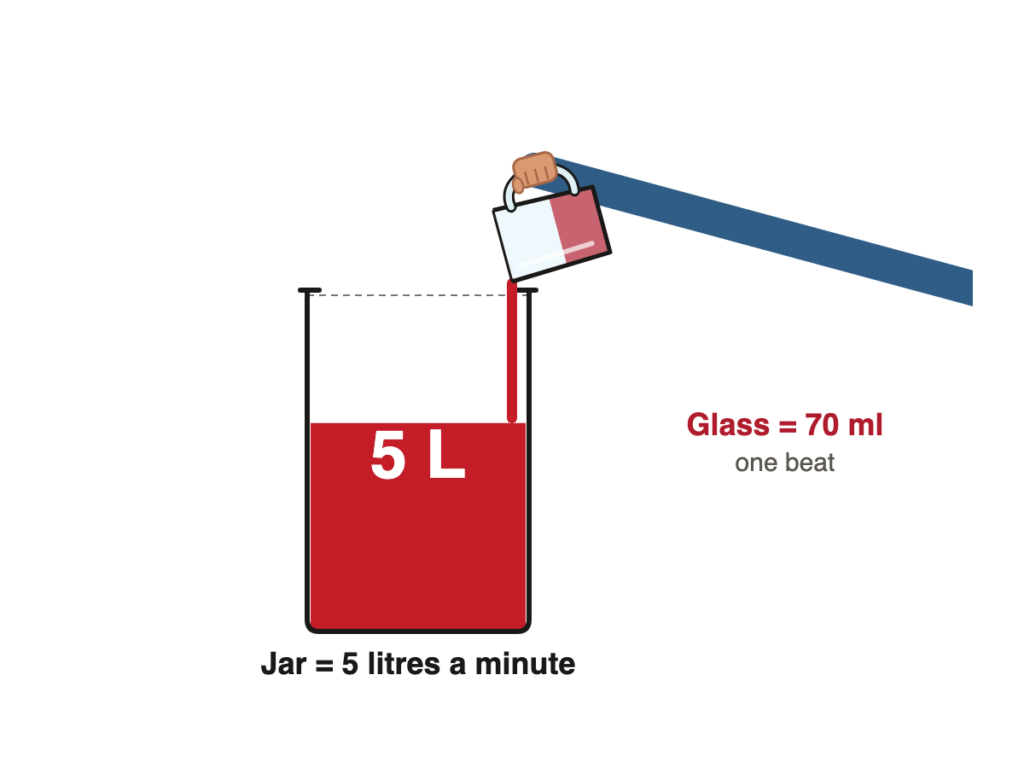
So cardiac output = heart rate x stroke volume. A normal heart pushes about 70 ml in each beat. To fill about 5 litres, it must beat about 72 times a minute. These are round numbers, used here to show how the sum works.
How endurance makes each beat bigger
With endurance training, week after week, the main pumping chamber (the left ventricle) grows wider, and its wall grows thicker with it. Doctors call this eccentric hypertrophy. The chamber becomes a bigger cup, so it holds and pushes more blood in each beat.
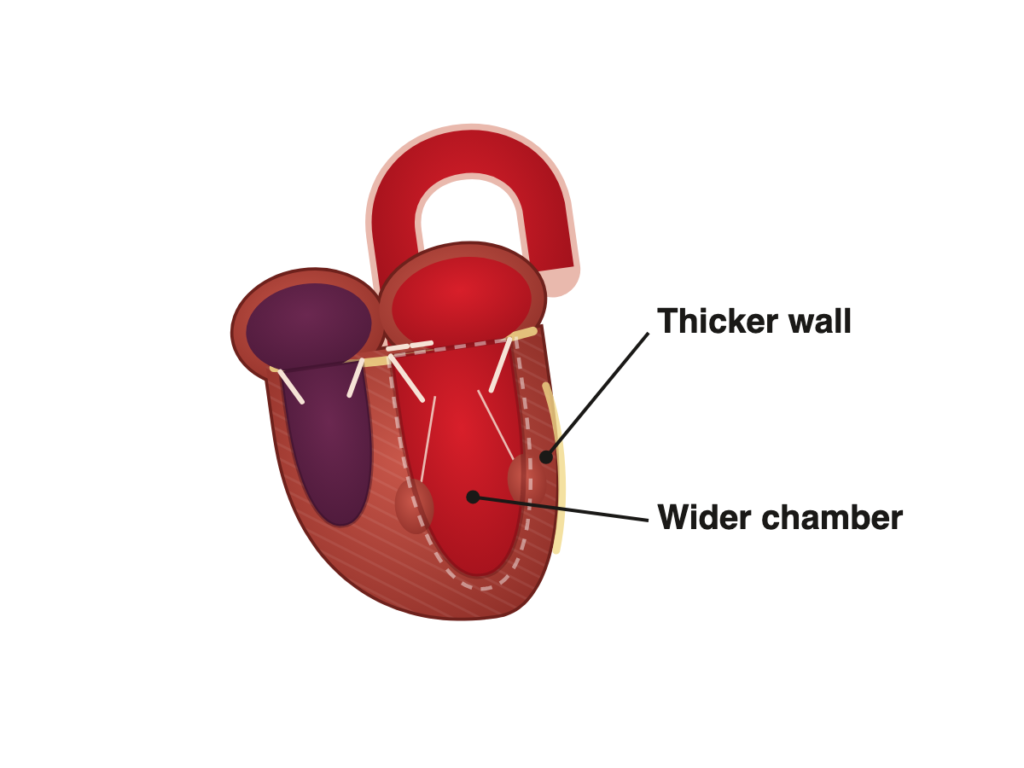
Now each beat pushes about 100 ml. The same 5 litres needs only about 50 beats a minute. Studies of trained athletes found bigger stroke volume and more blood volume than in untrained people.
About 30,000 fewer beats every day
72 minus 50 is 22 fewer beats a minute. Over a day that is 22 x 60 x 24 = 31,680 beats. That is about 30,000 fewer beats, for the same work.
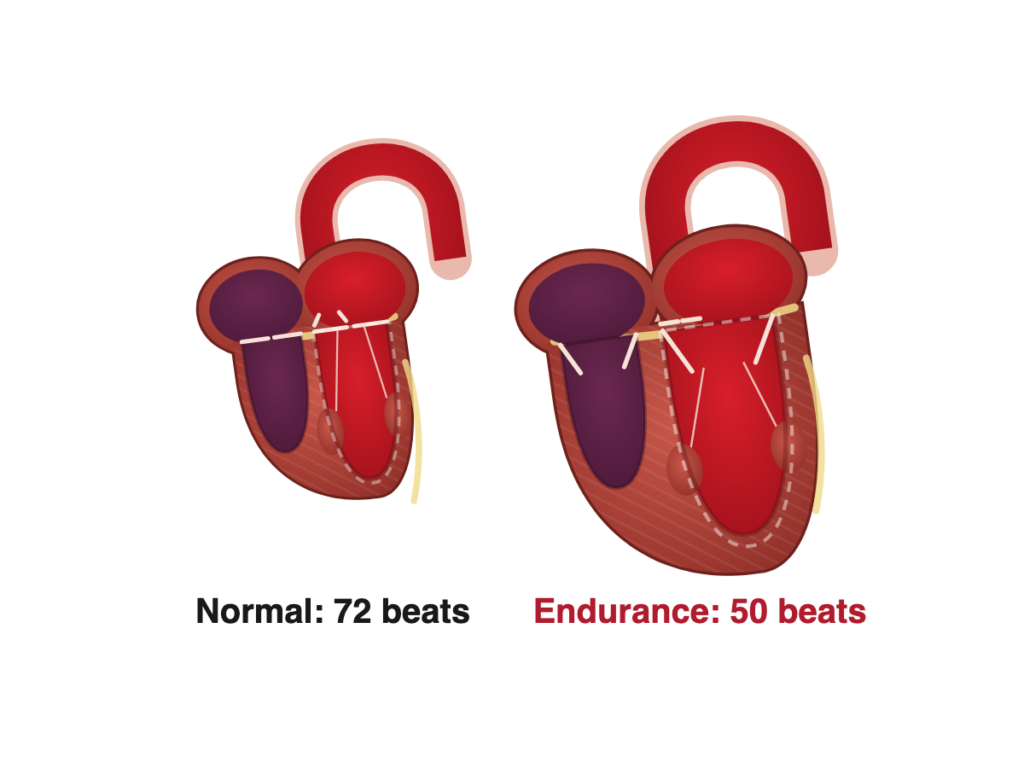
A lower resting heart rate is linked with longer life. In 46 studies of about 1.2 million people, every 10 extra beats a minute at rest came with about 9% higher risk of death. This shows a link, not proof that the pulse itself is the cause.
What this means for you
Check your resting heart rate in the morning, sitting quietly, before tea or coffee. A slower pulse that comes from fitness is a good sign. But a slow pulse with dizziness, fainting or breathlessness is not fitness. See your doctor about it.
If you have heart disease, endurance still matters, but it needs a plan. Physician supervised, exercise based cardiac rehab builds your endurance step by step, at a pace set for your heart. The runner’s side of this story is on the Telangana Runners blog: a runner’s heart beats less.
Your questions, answered
What is cardiac output?
Cardiac output is the blood your heart pushes out in one minute, about 5 litres at rest. It equals heart rate (beats in a minute) times stroke volume (blood pushed out in one beat). A slower heart can give the same output if each beat pushes more blood.
Why do runners have a lower resting heart rate?
Endurance training makes the main pumping chamber wider and its wall thicker. Each beat then pushes more blood, so fewer beats give the same 5 litres. Studies of trained athletes found bigger stroke volume and blood volume. The nerves that slow the heart also play a part.
Is a lower resting heart rate better?
In 46 studies of about 1.2 million people, every 10 extra beats a minute at rest came with about 9% higher risk of death. It is a link, not proof of cause. A low pulse from fitness is a good sign, but a slow pulse with dizziness or fainting needs a doctor’s check.
What is eccentric hypertrophy?
It is the change endurance training makes in the heart: the pumping chamber grows wider, and its wall grows thicker to match. The heart becomes a bigger cup. It is a healthy change from training, not the same as heart muscle thickening from disease.
Build your endurance, under physician supervision
Physician supervised, exercise based cardiac rehab builds your endurance step by step. General advice: your own doctor knows your health.
info@cardiacrehab.com · www.CardiacRehab.com
Cardiac Rehab, 7B Journalist Colony, Film Nagar, Jubilee Hills, Hyderabad, Telangana 500096
References
- Zhang D, Shen X, Qi X. Resting heart rate and all-cause and cardiovascular mortality in the general population: a meta-analysis. CMAJ. 2016;188(3):E53-E63. pubmed.ncbi.nlm.nih.gov/26598376
- Krip B, Gledhill N, Jamnik V, Warburton D. Effect of alterations in blood volume on cardiac function during maximal exercise. 1997 (summary: endurance-trained athletes have higher blood volumes and enhanced diastolic filling of the heart). coachsci.sdsu.edu/csa/vol71/krip.htm