
Short answer: Exercise and blood pressure were studied in 93 randomized trials. Endurance training lowered pressure most in people who started high: by 8.3 mm Hg systolic and 5.2 mm Hg diastolic. Athletes also have larger arteries, without higher pressure at rest. Whether wider arteries explain the fall is not shown.
In this article
- Blood pressure is the force of blood on the artery walls; the heart works like a motor pushing blood through pipes.
- A review of athletes found larger conduit arteries, and no higher pressure at rest or in exercise.
- In 93 trials of exercise (5,223 adults), endurance training lowered pressure by 3.5 / 2.5 mm Hg on average.
- In 26 endurance groups of people with high blood pressure, pressure fell by 8.3 / 5.2 mm Hg.
- Whether wider arteries explain the fall in pressure is not shown by these studies.
What high blood pressure asks of the heart
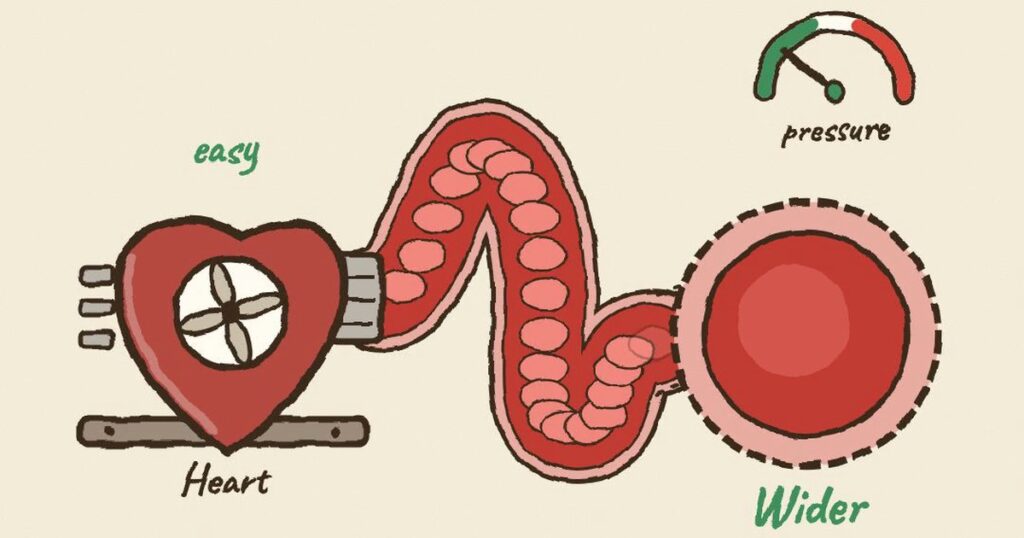
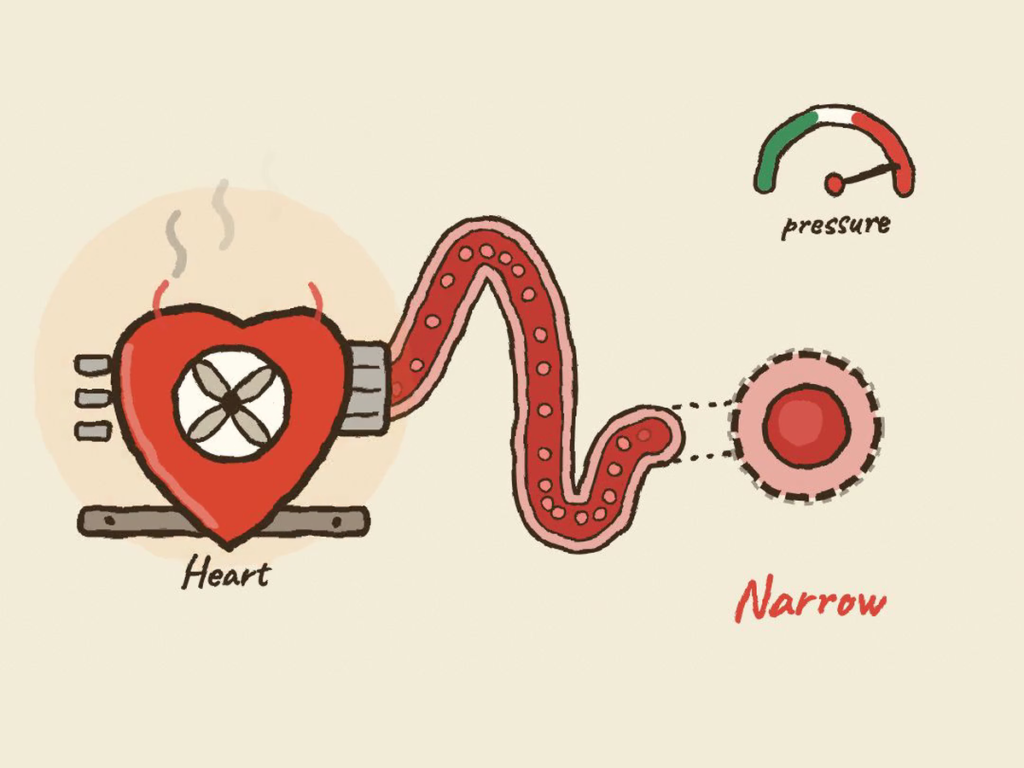
Think of your heart as a motor that pushes blood through a long system of pipes, your arteries. Blood pressure is the force the blood puts on the walls of those pipes. The first number, systolic, is the pressure when the heart pushes. The second number, diastolic, is the pressure between beats.
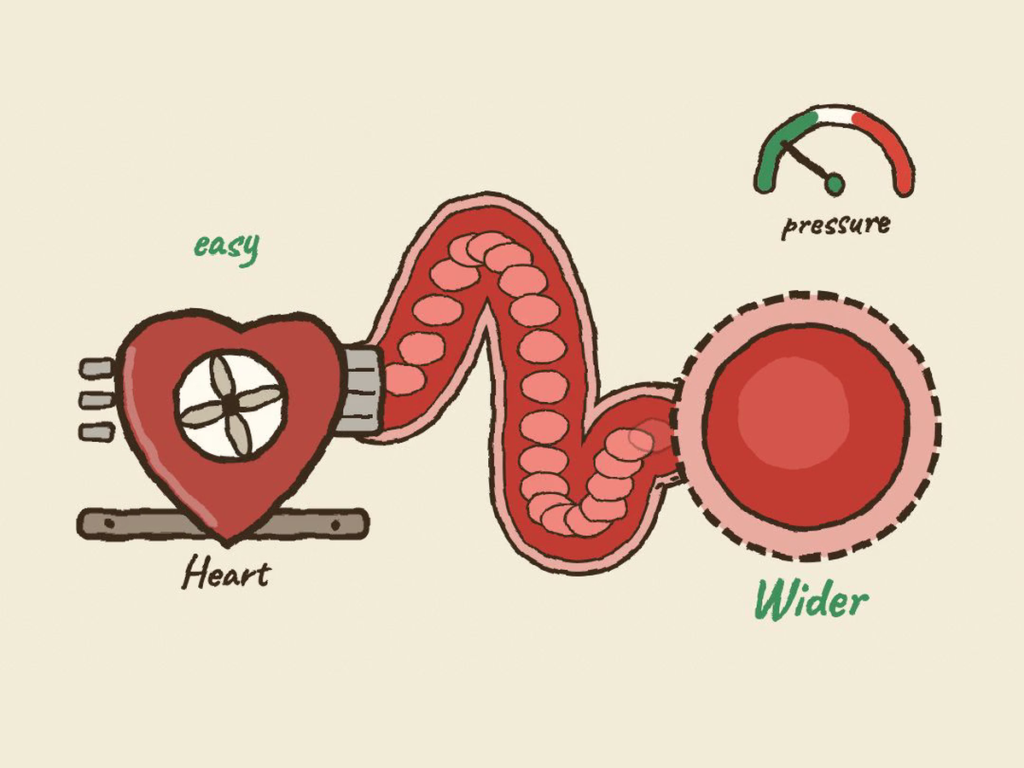
When the hole inside a pipe gets narrow, the motor has to push harder to move the same amount of blood. A heart pushing hard through narrow pipes is what we call high blood pressure. The drawing below shows the idea. It is a simple picture, because real arteries differ in size and in many other ways.
Do athletes have wider arteries?
A review of the arteries of athletes asked this question. Studies that compared athletes with matched people who were not athletes found larger conduit arteries, the large arteries that carry blood to the muscles. These were cross-sectional comparisons, so they come with caveats, and they do not show that training caused the difference.
The review links the larger arteries to repeated, short rises in blood flow during exercise, which put a stretching force on the lining of the artery. This force is called shear stress, and it can make the artery remodel and grow. The same review reports that arterial pressure is not higher at rest or during exercise in athletes than in other people.
A later review of how exercise changes arteries adds that exercise changes blood flow, shear stress, pressure and the stress in the artery wall, and that these changes can alter how an artery works, how wide it is and how thick its wall is. The authors say these direct effects on the artery wall help explain why physical activity lowers cardiovascular risk. In plain words, the pipe itself responds to the work it is asked to do.
Exercise and blood pressure: what 93 trials found
A meta-analysis of exercise and blood pressure pooled 93 randomized trials of at least 4 weeks, with 5,223 adults. The trials tested endurance, resistance and combined training. Across all endurance training groups, systolic pressure fell by 3.5 mm Hg (95% confidence interval 2.3 to 4.6) and diastolic pressure fell by 2.5 mm Hg (1.7 to 3.2).
The fall depended on where people started. In 26 endurance groups of people with high blood pressure, pressure fell by 8.3 mm Hg systolic and 5.2 mm Hg diastolic. In 50 groups of people with pre-hypertension, it fell by 2.1 and 1.7. In 29 groups of people with normal pressure, it fell by 0.75 and 1.1. The difference between the three starting points was statistically clear (P < 0.0001).
So the people who gained most were the people with the highest pressure. The paper reports that dynamic resistance training and isometric resistance training also lowered pressure, and that combined training lowered only the diastolic number. These are averages across many studies, and a single person can do better or worse.
Do wider arteries explain the fall in pressure?
We do not know. The studies on artery size in athletes and the trials on blood pressure are different kinds of evidence, and the abstracts we read do not connect the two. It is a reasonable idea that regular exercise changes how the arteries are built and how they work, and that this helps blood flow with less effort from the heart. It is still an idea.
What the evidence does say is simpler. Athletes have larger arteries without higher pressure at rest, and trials of endurance training lowered blood pressure, most in people who had high pressure. We show the pipe pictures as a way to see the idea, and we label them simplified.
What this means for you
If you have pre-hypertension or high blood pressure, start moving and build endurance, under physician supervision. Check your pressure with your doctor first, because blood pressure medicines, other conditions and your heart all change what is safe for you. Exercise is an addition to your treatment, and it does not replace it.
A physician supervised, exercise based programme chooses movements that are safe for you and adds effort step by step. Physician supervised, exercise based cardiac rehab works the same way. The runner’s side of this story is on the Telangana Runners blog: running and blood pressure.
Your questions, answered
Does running lower blood pressure?
Endurance training did in trials. A meta-analysis of 93 randomized trials found that endurance training lowered systolic pressure by 3.5 mm Hg and diastolic pressure by 2.5 mm Hg on average. The fall was larger in people with high blood pressure: 8.3 and 5.2 mm Hg in 26 groups.
Is the diastolic number lowered too?
Yes. In the same meta-analysis, the diastolic number fell by 2.5 mm Hg on average after endurance training, and by 5.2 mm Hg in groups of people with high blood pressure. In people with normal pressure the fall was 1.1 mm Hg.
Do athletes have wider arteries?
A review of studies in athletes found larger conduit arteries, the large arteries that carry blood to the muscles, compared with other people. It also reports no higher arterial pressure at rest or in exercise. The comparisons were cross-sectional, so they do not prove that training caused the larger arteries.
Do wider arteries lower blood pressure?
The studies we read do not show that. Artery size in athletes and the fall in pressure after training come from different kinds of studies, and the abstracts do not link the two. Wider arteries are a reasonable idea, and not a proven cause. The safest message is that endurance training lowered pressure in trials.
Start with your doctor
Ask about a physician supervised, exercise based programme that fits your heart and your blood pressure. Read more about cardiac rehab. General advice: your own doctor knows your health.
info@cardiacrehab.com · www.CardiacRehab.com
Cardiac Rehab, 7B Journalist Colony, Film Nagar, Jubilee Hills, Hyderabad, Telangana 500096
References
- Cornelissen VA, Smart NA. Exercise training for blood pressure: a systematic review and meta-analysis. J Am Heart Assoc. 2013;2(1):e004473. pubmed.ncbi.nlm.nih.gov/23525435
- Green DJ, Spence A, Rowley N, et al. Vascular adaptation in athletes: is there an ‘athlete’s artery’? Exp Physiol. 2012;97(3):295-304. pubmed.ncbi.nlm.nih.gov/22179421
- Green DJ, Hopman MTE, Padilla J, et al. Vascular adaptation to exercise in humans: role of hemodynamic stimuli. Physiol Rev. 2017;97(2):495-528. pubmed.ncbi.nlm.nih.gov/28151424