Short answer: Yes. In physician supervised, exercise based cardiac rehab, the working muscles drive every breath. Those deep, rhythmic breaths keep the lungs supple, make breathing more efficient, strengthen the vagus nerve and improve sleep. Fitness built this way is linked with 42% lower risk of stroke (Wang, Journal of Neurology, 2020), and cardiac rehab lowers the risk of another heart attack (Cochrane, 2021).
In this article
- Breathing exercises are a passive stimulus; endurance exercise is an active one, driven by the muscles, and its benefit held longer in trials. In exercise, the muscles set every breath — involuntary and mandatory.
- Deep breaths keep the lungs compliant; training improved lung diffusion by 25% in heart failure.
- Fitness protects lung function over 20–25 years, makes breathing efficient and the breathing muscles strong. Training raises vagal tone and improves sleep.
- Fitness is linked with 42% lower stroke risk; cardiac rehab lowers heart attacks (relative risk 0.72).
- Our programme: about 100 hours over 36 weeks. South-East Asia has one cardiac rehab place for every 283 heart patients.
What did World Lung Day remind us?
On World Lung Day, a Nagpur lung specialist told the Times of India that lung health is “a window to the health of the whole body”. We agree, and we want to add what to do about it. At Cardiac Rehab in Film Nagar, Jubilee Hills, Hyderabad, our programme is about 100 hours over 36 weeks of supervised, step-by-step exercise that makes the lungs work for the heart, the nerves and sleep.
On 25 September 2026 the Times of India quoted Dr Sushant Meshram, head of Pulmonary, Critical Care and Sleep Medicine at Government Medical College, Nagpur. Lung health, he said, is linked to the heart, the brain, the muscles and overall wellbeing. Chronic lung disease caused around 1.25 million deaths in India in 2021. He warned that “lung and heart diseases can influence each other”, and that inactivity drives “a cycle of breathlessness and declining exercise capacity”.
That cycle is the problem this article is about. A person who is short of breath does less. Doing less makes the heart, the muscles and the lungs weaker. And the weaker they get, the shorter the breath.
Why is sitting and breathing not enough?
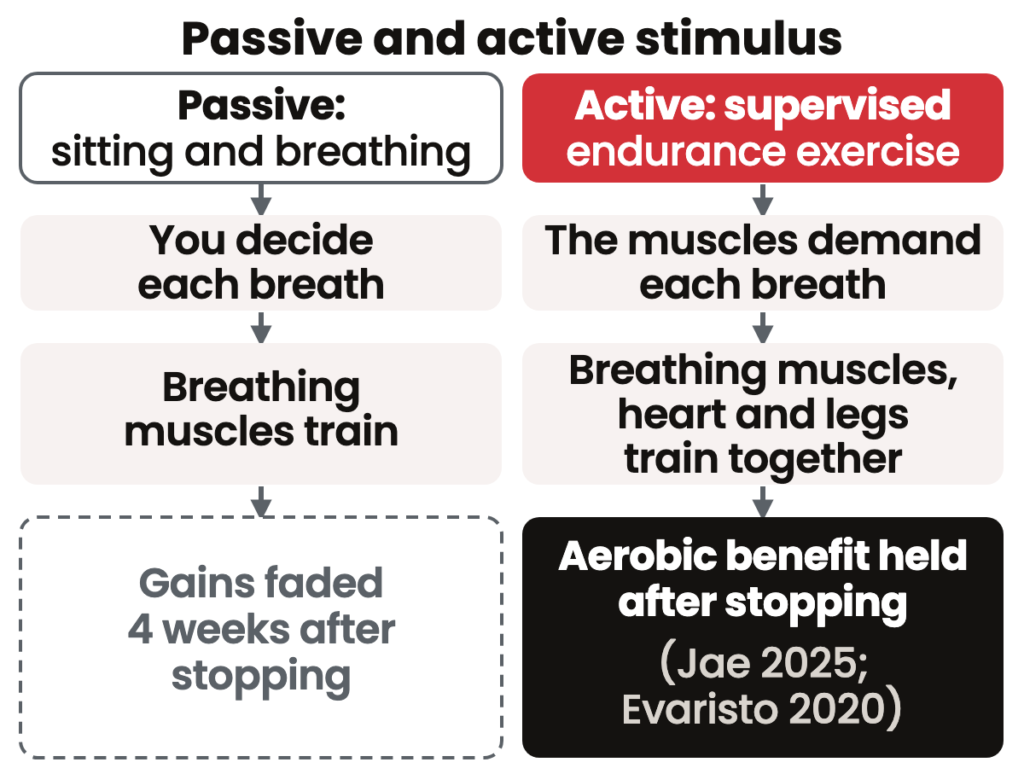
Breathing exercises are a passive stimulus. You sit, you breathe on purpose, and only the breathing muscles work, for as long as you remember to do them. Endurance exercise is an active stimulus. The working muscles demand every breath, and the heart, the legs and the lungs all train together. That difference shows when people stop:
- In a trial of 28 people with high blood pressure, breathing-muscle training and aerobic exercise lowered blood pressure by a similar amount in 8 weeks. Four weeks after stopping, only the aerobic group kept the benefit (Jae et al., Clinical Hypertension, 2025).
- In a trial of 54 people with asthma, aerobic training and breathing exercises did equally well at the end. Three months later, the aerobic group was 2.6 times more likely to be clinically better (Evaristo et al., Journal of Allergy and Clinical Immunology: In Practice, 2020).
- The gains from breathing-muscle training alone — in strength and in vagal tone — were gone four weeks after it stopped (Rodrigues et al., Experimental Gerontology, 2021).
Any training fades if it stops for long. That is why cardiac rehab builds a habit that lasts, not a set of exercises to remember.
How does supervised exercise train the lungs? The mechanism
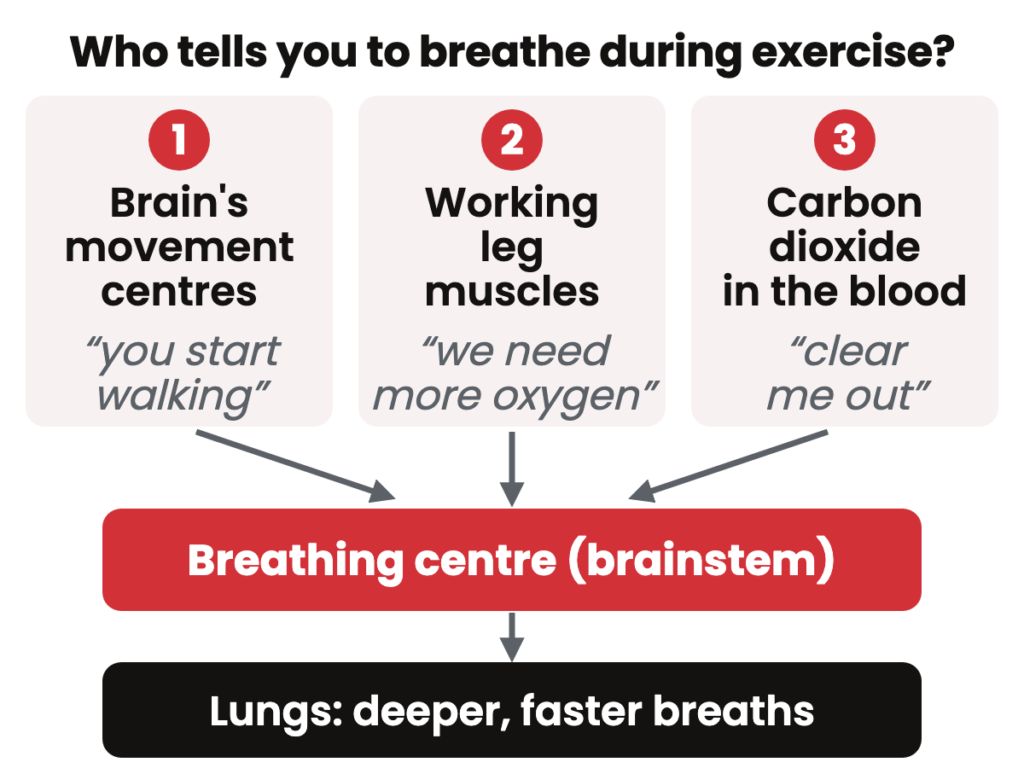
The muscles set the breath, automatically. When you walk faster on a treadmill in cardiac rehab, you do not decide to breathe harder. It happens on its own. Three automatic inputs drive breathing in exercise: a signal from the brain’s movement centres, signals from the working muscles, and the carbon dioxide the muscles make (Dempsey et al., Handbook of Clinical Neurology, 2022).
The muscles are in charge. When the nerve signals from the working leg muscles were blocked, people consistently breathed too little during exercise (Dempsey, Blain and Amann, Journal of Physiology, 2014). So in exercise the breathing drive is involuntary and mandatory. It cannot be skipped, forgotten or done half-heartedly.
Each step up in workload: deeper breaths, in rhythm
The air you breathe rises in step with the oxygen the body uses (Forster, Haouzi and Dempsey, Comprehensive Physiology, 2012). In cardiac rehab the physician titrates the workload — raising it a little at a time, with heart rate, blood pressure and symptoms watched. Each step asks the lungs to expand more and relax more, in rhythm with the exercise, for the whole session. Over about 100 hours in 36 weeks, that is thousands of minutes of the lungs working in time with the heart and the legs.
Is it safe to exercise if I get breathless? It is safest when supervised. In cardiac rehab a physician sets the workload from your tests, watches heart rate, blood pressure and symptoms, and raises the load one step at a time. New or worsening breathlessness should always be checked by a doctor before you start.
Deep breaths keep the lungs compliant
A compliant lung is one that stretches easily. Shallow breathing lets some of the tiny air sacs partly close. A breath more than twice the normal size reopens them, “thereby increasing lung compliance” (Severs, Vlemincx and Ramirez, Biological Psychology, 2022). The stretch of each deep breath is also the main trigger for the lung to release surfactant, the lining that lets the air sacs open easily (Edwards, 2001). Exercise gives the lungs hundreds of these deep breaths every session.
In heart failure the lungs become stiff, and that stiffness drives fast, shallow breathing during effort (Agostoni et al., Journal of Applied Physiology, 2002). Training reaches the lung here too. In heart failure patients, eight weeks of cycling improved the lung’s ability to pass oxygen into the blood by 25%, and cut the breath needed for each unit of carbon dioxide by 14% (Guazzi et al., Journal of Applied Physiology, 2004). No trial has yet measured compliance itself before and after a training programme.
Fitness protects lung function for years
- 20 years, 3,332 people. In the US CARDIA study, each extra minute on a treadmill test meant a slower yearly fall in FEV1 and FVC. Each minute of fitness lost meant a faster fall — 2.54 mL more FEV1 lost every year. Keeping or gaining fitness “were associated with preservation of lung health” (Benck et al., American Journal of Respiratory and Critical Care Medicine, 2017).
- 25 years, Finnish men. The most active lost 9.8 mL less FEV1 a year than the least active, in smokers and non-smokers alike (Pelkonen et al., same journal, 2003).
- Older athletes. Men who had trained for endurance for years had lung volumes and FEV1 well above what was expected for their age (Hagberg et al., Journal of Applied Physiology, 1988).
Breathing becomes efficient, and the breathing muscles strong
- In heart failure, aerobic training improved the VE/VCO2 slope — the breath needed for each unit of carbon dioxide — by 6.55 points in a meta-analysis (Cipriano et al., Heart Failure Reviews, 2014).
- After angioplasty, six months of aerobic training improved breathing efficiency, still present at 12 months (Vasiliauskas et al., Scandinavian Cardiovascular Journal, 2007).
- In 456 heart failure patients, five months of aerobic cardiac rehab raised the strength of the breathing muscles in 71.5% of them. Each gain of 10 cmH2O went with 23% fewer deaths or readmissions (Hamazaki et al., Journal of Clinical Medicine, 2020).
In plain words: the same walk costs you less breath, and your breathing muscles are stronger for it.
How do the lungs talk to the heart? The vagus nerve
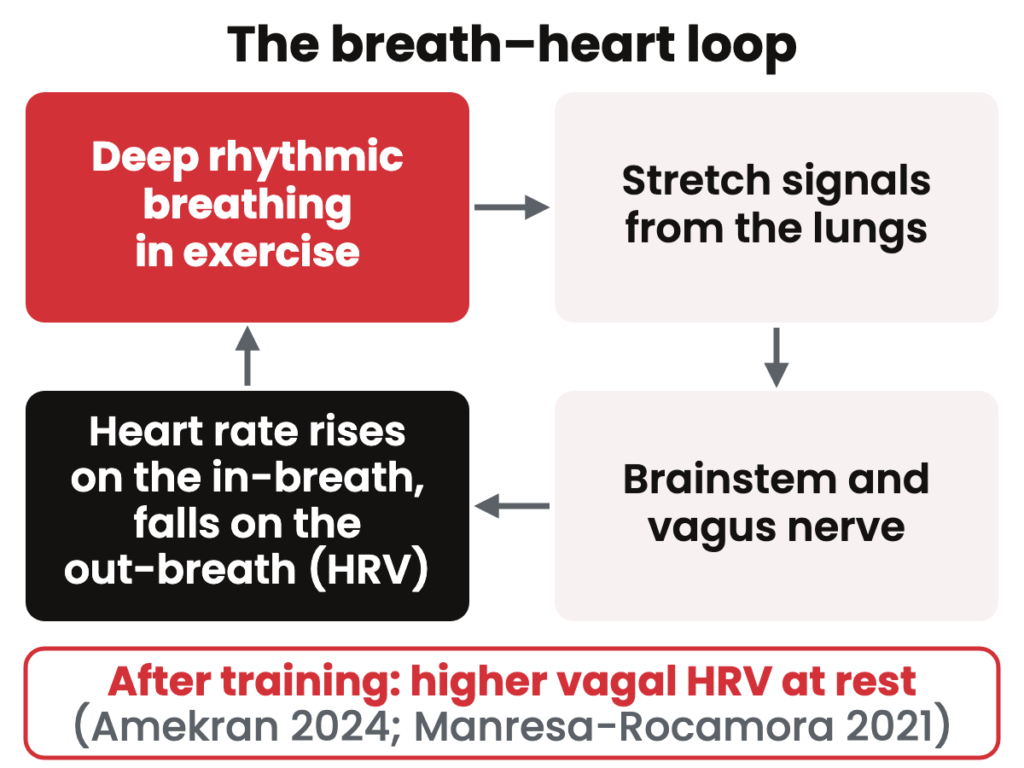
The lungs and the heart are joined by the vagus nerve, the body’s “rest and repair” nerve. With every breath the heart speeds a little as you breathe in and slows as you breathe out. This swing is called heart rate variability (HRV). The bigger and slower the breath, the bigger the swing. The swing grows in a straight line with the size of the breath (Hirsch and Bishop, American Journal of Physiology, 1981), and larger breaths give a larger swing (Freyschuss and Melcher, 1975).
Endurance training raises this vagal tone at rest. In 16 randomised trials of healthy adults, exercise training raised the vagal HRV measures RMSSD and HF power (Amekran and El Hangouche, Cureus, 2024). In heart patients, exercise based cardiac rehab improved RMSSD and made the heart rate settle about 5 beats per minute faster after effort (Manresa-Rocamora et al., Clinical Autonomic Research, 2021).
What does vagal tone have to do with sleep?
In a 12-week trial of adults over 40 who slept badly, aerobic training improved both sleep quality and vagal HRV, and the two improved together (Tseng et al., Journal of Clinical Sleep Medicine, 2020). A review of trials in the same age group found exercise improved sleep quality and helped people fall asleep sooner (Yang et al., Journal of Physiotherapy, 2012). In heart patients, sleep scores improved after eight weeks of cardiac rehab (Lodi Rizzini et al., 2022).
Does it lower heart attacks and strokes?
Yes. The evidence comes from millions of people. Stroke. Across 14 studies and 1.4 million people, the fittest had 42% lower risk of stroke than the least fit (relative risk 0.58), for both ischaemic and haemorrhagic stroke (Wang et al., Journal of Neurology, 2020). Getting fitter counts: each step up in fitness between two tests meant 9% lower risk of ischaemic stroke (Ehrman et al., Journal of Stroke and Cerebrovascular Diseases, 2023).
- Heart attack. Each step up in fitness (1 MET) meant 15% lower risk of coronary and cardiovascular events (relative risk 0.85) (Kodama et al., JAMA, 2009).
- Cardiac rehab itself. The 2021 Cochrane review of 85 trials and 23,430 people found exercise based cardiac rehab reduced heart attacks (relative risk 0.72, high certainty) and hospital admissions (relative risk 0.58). Over more than three years, cardiovascular deaths were lower (relative risk 0.58) (Dibben et al., Cochrane Database of Systematic Reviews, 2021).
- The vagal link. Low HRV marks higher risk: after a heart attack, the lowest HRV carried 5.3 times the death rate of the highest (Kleiger et al., 1987).
The dose matters. Among 30,161 older patients in the US, those who attended all 36 sessions had a 47% lower risk of death over four years than those who attended one (Hammill et al., Circulation, 2010). Our programme is about 100 hours over 36 weeks.
Why so few people get it: the gap
Cardiac rehab is one of the most proven and least used treatments in heart care. Across South-East Asia there is one cardiac rehab place for every 283 heart patients, against one for every 12 worldwide. The cardiac rehab programmes that exist deliver about 17 hours on average, against 36 hours globally (Chowdhury et al., WHO South-East Asia Journal of Public Health, 2021). Most people who leave hospital after a heart attack, angioplasty or bypass in Hyderabad and across Telangana are never sent. Many are told to “walk a little” and are left to guess how much.
This article is for general information and does not replace a consultation. Anyone with new chest pain or breathlessness should see a doctor first.
Your questions, answered
Can cardiac rehab improve my lung function?
Yes, in the ways that matter. Aerobic training makes breathing more efficient, strengthens the breathing muscles and, in heart failure, improved the lung’s ability to pass oxygen into the blood by 25%. Over years, people who stay fit lose lung function more slowly. The blowing-test numbers themselves move slowly, so the gain shows over time.
Are breathing exercises enough after a heart attack?
They help, but they are a passive stimulus: you sit and breathe, and only the breathing muscles work. Endurance exercise is active: the muscles demand every breath, and heart, legs and lungs train together. In trials comparing the two, the aerobic benefit lasted after stopping and the breathing-only benefit did not.
How long is a cardiac rehab programme?
The international standard is 36 one-hour sessions, and the world average is about 36 hours. Our programme at Cardiac Rehab, Film Nagar, Jubilee Hills, Hyderabad is about 100 hours over 36 weeks of physician supervised exercise, stepped up gradually. In trials, people who completed all 36 sessions had better survival than those who stopped early.
Does exercise lower the risk of stroke?
Yes. Across 1.4 million people, the fittest had 42% lower risk of stroke than the least fit. Getting fitter counts too: each step up in fitness lowered the risk of ischaemic stroke by 9%. Cardiac rehab builds that fitness under a physician’s supervision.
What is heart rate variability, and why does it matter?
It is the small beat-to-beat change in your heart rate, set largely by the vagus nerve. It rises with each in-breath and falls with each out-breath, and bigger breaths make the swing bigger. Endurance training raises it at rest. Low variability after a heart attack is linked with a much higher risk of death.
Will exercise help me sleep better?
Very likely. In a 12-week trial of adults over 40 who slept badly, aerobic training improved sleep quality and vagal tone together. Heart patients’ sleep scores also improved after cardiac rehab. If you snore or stop breathing at night, ask to be checked for sleep apnoea.
Start your cardiac rehab
Physician Supervised Exercise Based Cardiac Rehab — after a heart attack, angioplasty, bypass surgery or heart failure, before cardiac surgery, and to prevent heart attacks. Read the everyday version for runners and walkers on Telangana Runners: Does running make your lungs stronger?
info@cardiacrehab.com · www.CardiacRehab.com
Cardiac Rehab, 7B Journalist Colony, Film Nagar, Jubilee Hills, Hyderabad, Telangana 500096
References
- Ahmed S. Healthy lungs vital for heart, brain and overall well-being: Experts. The Times of India (Nagpur), 25 Sep 2026. timesofindia.indiatimes.com/city/nagpur/healthy-lungs-vital-for-heart-brain-and-overall-well-being-experts/articleshow/134469394.cms
- Jae SY, Choi TG, Kim HJ, Kunutsor SK. Comparison of inspiratory muscle strength and aerobic exercise training and detraining on blood pressure in hypertensive patients. Clin Hypertens 2025;31:e15. doi.org/10.5646/ch.2025.31.e15
- Evaristo KB, Mendes FAR, Saccomani MG, et al. Effects of aerobic training versus breathing exercises on asthma control: a randomized trial. J Allergy Clin Immunol Pract 2020;8(9):2989–2996. doi.org/10.1016/j.jaip.2020.06.042
- Rodrigues GD, Dal Lago P, da Silva Soares PP. Time-dependent effects of inspiratory muscle training and detraining on cardiac autonomic control in older women. Exp Gerontol 2021;150:111357. doi.org/10.1016/j.exger.2021.111357
- Dempsey JA, Neder JA, Phillips DB, O’Donnell DE. The physiology and pathophysiology of exercise hyperpnea. Handb Clin Neurol 2022;188:201–232. doi.org/10.1016/B978-0-323-91534-2.00001-1
- Dempsey JA, Blain GM, Amann M. Are type III-IV muscle afferents required for a normal steady-state exercise hyperpnoea in humans? J Physiol 2014;592(3):463–474. doi.org/10.1113/jphysiol.2013.261925
- Forster HV, Haouzi P, Dempsey JA. Control of breathing during exercise. Compr Physiol 2012;2(1):743–777. doi.org/10.1002/cphy.c100045
- Severs LJ, Vlemincx E, Ramirez JM. The psychophysiology of the sigh: I: The sigh from the physiological perspective. Biol Psychol 2022;170:108313. doi.org/10.1016/j.biopsycho.2022.108313
- Edwards YS. Stretch stimulation: its effects on alveolar type II cell function in the lung. Comp Biochem Physiol A 2001;129(1):245–260. doi.org/10.1016/s1095-6433(01)00321-x
- Agostoni P, Pellegrino R, Conca C, Rodarte JR, Brusasco V. Exercise hyperpnea in chronic heart failure: relationships to lung stiffness and expiratory flow limitation. J Appl Physiol 2002;92(4):1409–1416. doi.org/10.1152/japplphysiol.00724.2001
- Guazzi M, Reina G, Tumminello G, Guazzi MD. Improvement of alveolar-capillary membrane diffusing capacity with exercise training in chronic heart failure. J Appl Physiol 2004;97(5):1866–1873. doi.org/10.1152/japplphysiol.00365.2004
- Benck LR, Cuttica MJ, Colangelo LA, et al. Association between cardiorespiratory fitness and lung health from young adulthood to middle age. Am J Respir Crit Care Med 2017;195(9):1236–1243. doi.org/10.1164/rccm.201610-2089OC
- Pelkonen M, Notkola IL, Lakka T, et al. Delaying decline in pulmonary function with physical activity: a 25-year follow-up. Am J Respir Crit Care Med 2003;168(4):494–499. doi.org/10.1164/rccm.200208-954OC
- Hagberg JM, Yerg JE 2nd, Seals DR. Pulmonary function in young and older athletes and untrained men. J Appl Physiol 1988;65(1):101–105. doi.org/10.1152/jappl.1988.65.1.101
- Cipriano G Jr, Cipriano VT, da Silva VZ, et al. Aerobic exercise effect on prognostic markers for systolic heart failure patients: a systematic review and meta-analysis. Heart Fail Rev 2014;19(5):655–667. doi.org/10.1007/s10741-013-9407-6
- Vasiliauskas D, Benetis R, Jasiukeviciene L, et al. Exercise training after coronary angioplasty improves cardiorespiratory function. Scand Cardiovasc J 2007;41(3):142–148. doi.org/10.1080/14017430601187116
- Hamazaki N, Kamiya K, Yamamoto S, et al. Changes in respiratory muscle strength following cardiac rehabilitation for prognosis in patients with heart failure. J Clin Med 2020;9(4):952. doi.org/10.3390/jcm9040952
- Hirsch JA, Bishop B. Respiratory sinus arrhythmia in humans: how breathing pattern modulates heart rate. Am J Physiol 1981;241(4):H620–H629. doi.org/10.1152/ajpheart.1981.241.4.H620
- Freyschuss U, Melcher A. Sinus arrhythmia in man: influence of tidal volume and oesophageal pressure. Scand J Clin Lab Invest 1975;35(6):487–496. PMID 1105758 pubmed.ncbi.nlm.nih.gov/1105758
- Amekran Y, El Hangouche AJ. Effects of exercise training on heart rate variability in healthy adults: a systematic review and meta-analysis of randomized controlled trials. Cureus 2024;16(6):e62465. doi.org/10.7759/cureus.62465
- Manresa-Rocamora A, Ribeiro F, Sarabia JM, et al. Exercise-based cardiac rehabilitation and parasympathetic function in patients with coronary artery disease. Clin Auton Res 2021;31(2):187–203. doi.org/10.1007/s10286-020-00687-0
- Tseng TH, Chen HC, Wang LY, Chien MY. Effects of exercise training on sleep quality and heart rate variability in middle-aged and older adults with poor sleep quality: a randomized controlled trial. J Clin Sleep Med 2020;16(9):1483–1492. doi.org/10.5664/jcsm.8560
- Yang PY, Ho KH, Chen HC, Chien MY. Exercise training improves sleep quality in middle-aged and older adults with sleep problems: a systematic review. J Physiother 2012;58(3):157–163. doi.org/10.1016/S1836-9553(12)70106-6
- Lodi Rizzini F, Gómez-González AM, Conejero-Cisneros R, et al. Effects of cardiac rehabilitation on sleep quality in heart disease patients with and without heart failure. Int J Environ Res Public Health 2022;19(24):16675. doi.org/10.3390/ijerph192416675
- Wang Y, Li F, Cheng Y, Gu L, Xie Z. Cardiorespiratory fitness as a quantitative predictor of the risk of stroke: a dose-response meta-analysis. J Neurol 2020;267(2):491–501. doi.org/10.1007/s00415-019-09612-6
- Ehrman JK, Keteyian SJ, Johansen MC, et al. Improved cardiorespiratory fitness is associated with lower incident ischemic stroke risk: Henry Ford FIT project. J Stroke Cerebrovasc Dis 2023;32(8):107240. doi.org/10.1016/j.jstrokecerebrovasdis.2023.107240
- Kodama S, Saito K, Tanaka S, et al. Cardiorespiratory fitness as a quantitative predictor of all-cause mortality and cardiovascular events in healthy men and women: a meta-analysis. JAMA 2009;301(19):2024–2035. doi.org/10.1001/jama.2009.681
- Dibben G, Faulkner J, Oldridge N, et al. Exercise-based cardiac rehabilitation for coronary heart disease. Cochrane Database Syst Rev 2021;11:CD001800. doi.org/10.1002/14651858.CD001800.pub4
- Kleiger RE, Miller JP, Bigger JT Jr, Moss AJ. Decreased heart rate variability and its association with increased mortality after acute myocardial infarction. Am J Cardiol 1987;59(4):256–262. doi.org/10.1016/0002-9149(87)90795-8
- Hammill BG, Curtis LH, Schulman KA, Whellan DJ. Relationship between cardiac rehabilitation and long-term risks of death and myocardial infarction among elderly Medicare beneficiaries. Circulation 2010;121(1):63–70. doi.org/10.1161/CIRCULATIONAHA.109.876383
- Chowdhury M, Heald FA, Turk-Adawi K, et al. Availability and delivery of cardiac rehabilitation in South-East Asia: how does it compare globally? WHO South East Asia J Public Health 2021;10(2):57–65. doi.org/10.4103/WHO-SEAJPH.WHO-SEAJPH_62_21